

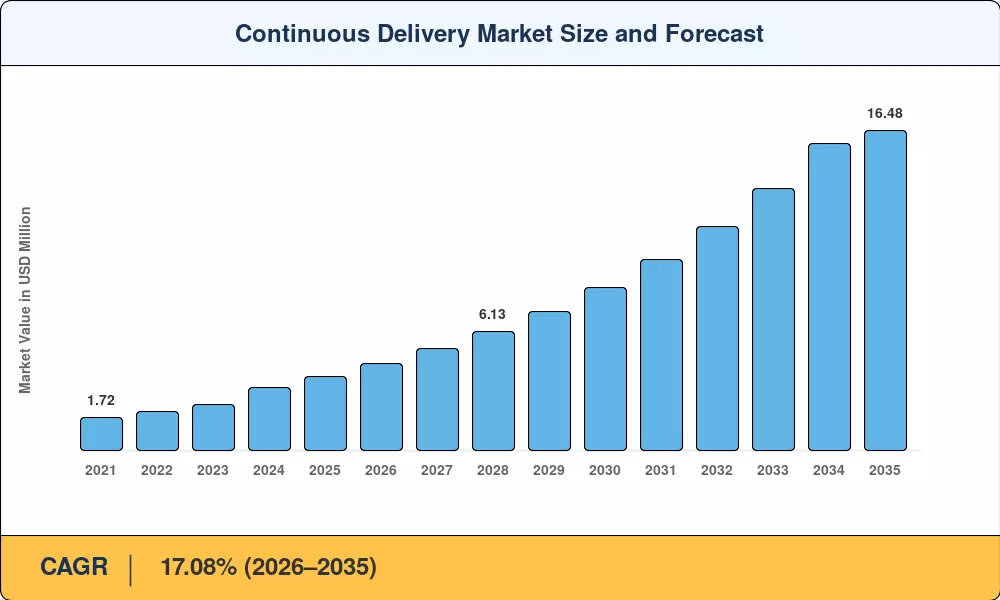
Continuous Delivery Market Expected to Grow to USD 16.48 Billion, with a 17.08% CAGR by 2035
Continuous Delivery Market
Continuous Delivery Market is expanding rapidly as businesses adopt automated software deployment to improve speed, quality, and operational efficiency.
Continuous Delivery is transforming software development by enabling faster releases, reducing deployment risks, and helping organizations deliver innovation at scale.”
NEW YORK, CA, UNITED STATES, June 10, 2026 /EINPresswire.com/ -- The global Continuous Delivery Market is experiencing significant growth as organizations increasingly adopt DevOps practices, cloud-native architectures, and agile software development methodologies. Continuous delivery enables development teams to automate software deployment processes, improve release frequency, and reduce operational risks associated with software updates. The market reached an estimated value of USD 3.82 billion in 2025. It is projected to grow from USD 4.47 billion in 2026 to approximately USD 16.48 billion by 2035, registering a robust compound annual growth rate (CAGR) of 17.08% during the forecast period.— Market Research Future
Growing demand for faster software releases, increasing adoption of microservices, and rising investments in digital transformation initiatives are expected to drive market expansion globally. Enterprises across industries are prioritizing continuous delivery solutions to enhance software quality, accelerate innovation, and improve customer experiences.
Get a Sample PDF of the Report at - https://www.marketresearchfuture.com/sample_request/24119
➤ Market Dynamics: Drivers, Restraints, and Opportunities
Market Drivers
Rising Adoption of DevOps Practices
Organizations are increasingly implementing DevOps frameworks to streamline software development and IT operations. Continuous delivery serves as a core component of DevOps by enabling automated testing, integration, and deployment processes. This approach reduces deployment errors and shortens release cycles.
Growing Demand for Faster Time-to-Market
Businesses face intense competition in digital markets, requiring rapid application updates and feature releases. Continuous delivery platforms help organizations deploy software more frequently while maintaining quality and security standards.
Expansion of Cloud Computing
The widespread adoption of cloud infrastructure has created favorable conditions for continuous delivery implementation. Cloud environments offer scalability, flexibility, and automation capabilities that support continuous integration and delivery pipelines.
Increasing Focus on Software Quality
Automated testing and deployment mechanisms embedded within continuous delivery frameworks help organizations identify bugs earlier in the development lifecycle, resulting in improved software reliability and customer satisfaction.
Market Restraints
Security and Compliance Concerns
Highly regulated industries such as banking, healthcare, and government sectors often face challenges in implementing continuous delivery due to strict compliance requirements and data security concerns.
Complex Integration Challenges
Many enterprises operate legacy systems that may not easily integrate with modern continuous delivery tools. The complexity of migrating existing workflows can increase implementation costs and timelines.
Shortage of Skilled Professionals
Successful deployment of continuous delivery solutions requires expertise in DevOps, cloud technologies, automation, and software engineering. The lack of skilled professionals remains a significant challenge for many organizations.
Market Opportunities
AI-Driven Automation
Artificial intelligence and machine learning technologies are increasingly being integrated into continuous delivery platforms. These capabilities enable predictive testing, automated issue detection, and intelligent deployment recommendations.
Growth of Containerization Technologies
The rising popularity of containers and orchestration platforms creates new opportunities for continuous delivery vendors. Automated deployment pipelines are becoming essential for managing containerized applications at scale.
Expansion Among Small and Medium Enterprises
As cloud-based continuous delivery solutions become more affordable, small and medium-sized businesses are expected to emerge as a major growth segment over the forecast period.
➤ Key Players and Competitive Insights
The continuous delivery market is characterized by intense competition among software vendors, cloud providers, and DevOps platform developers. Market participants focus on product innovation, strategic partnerships, acquisitions, and AI-powered automation capabilities to strengthen their competitive positions.
Major companies operating in the market include:
• Microsoft
• IBM
• GitLab
• Atlassian
• Red Hat
• CloudBees
• JFrog
• Harness
• CircleCI
• Broadcom
Competitive differentiation increasingly centers on automation capabilities, security integration, cloud-native support, and developer experience improvements.
Market Segmentations
By Component
• Solutions
• Services
By Deployment Mode
• Cloud-Based
• On-Premises
By Organization Size
• Large Enterprises
• Small and Medium Enterprises (SMEs)
By Industry Vertical
• Banking, Financial Services and Insurance (BFSI)
• Information Technology and Telecommunications
• Healthcare
• Retail and E-commerce
• Manufacturing
• Government and Public Sector
• Media and Entertainment
• Others
By Application
• Software Development
• Infrastructure Automation
• Application Release Management
• Testing and Quality Assurance
• Security and Compliance Management
Browse A Full Report: (Including Full TOC, List Of Tables & Figures) - https://www.marketresearchfuture.com/reports/continuous-delivery-market-24119
➤ Regional Insights
North America
North America remains the largest market for continuous delivery solutions due to strong adoption of DevOps practices, advanced cloud infrastructure, and the presence of leading technology companies. The United States continues to drive regional growth through significant investments in digital transformation initiatives.
Europe
Europe represents a substantial market share supported by increasing enterprise modernization efforts and growing adoption of cloud-native applications. Countries such as Germany, the United Kingdom, and France are leading regional demand.
Asia-Pacific
Asia-Pacific is expected to witness the fastest growth during the forecast period. Rapid digitalization, expanding IT sectors, and increasing cloud adoption across China, India, Japan, South Korea, and Southeast Asian countries are contributing significantly to market expansion.
Latin America
Organizations across Latin America are gradually embracing DevOps and automation technologies to improve operational efficiency and software delivery capabilities.
Middle East and Africa
Growing investments in smart city projects, digital government initiatives, and enterprise modernization programs are supporting continuous delivery adoption across the region.
➤ Recent Developments
• Organizations are increasingly integrating artificial intelligence into software delivery pipelines.
• DevSecOps adoption is expanding as businesses prioritize security throughout the software development lifecycle.
• Cloud-native continuous delivery platforms are gaining traction among enterprises undergoing digital transformation.
• Container orchestration technologies are becoming standard components of modern deployment pipelines.
• Software vendors continue to introduce automated testing and release management features to improve deployment reliability.
➤ Frequently Asked Questions (FAQs)
What is continuous delivery?
Ans - Continuous delivery is a software development practice that automates the building, testing, and deployment of applications, enabling organizations to release updates quickly and reliably.
What is driving growth in the continuous delivery market?
Ans - Key growth factors include DevOps adoption, cloud computing expansion, demand for faster software releases, and increasing digital transformation initiatives.
Which region dominates the continuous delivery market?
Ans - North America currently leads the market due to advanced technology infrastructure and widespread adoption of DevOps methodologies.
Which industry sectors use continuous delivery solutions?
Ans - Major users include BFSI, healthcare, IT and telecommunications, retail, manufacturing, and government organizations.
How does continuous delivery benefit organizations?
Ans - Continuous delivery improves software quality, accelerates release cycles, reduces deployment risks, enhances customer satisfaction, and supports business agility.
➤➤ Explore More Market Research Future Reports:
Customer Data Platform Market -
https://www.marketresearchfuture.com/reports/customer-data-platform-market-31630
Data Wrangling Market -
https://www.marketresearchfuture.com/reports/data-wrangling-market-31726
Contract Management Software Market -
https://www.marketresearchfuture.com/reports/contract-management-software-market-42111
Data Integration Market -
https://www.marketresearchfuture.com/reports/data-integration-market-42117
Philippines Data Center Market -
https://www.marketresearchfuture.com/reports/philippines-data-center-market-24266
Consumer Iot Market -
https://www.marketresearchfuture.com/reports/consumer-iot-market-28827
Digital Accessibility Software Market -
https://www.marketresearchfuture.com/reports/digital-accessibility-software-market-29249
Devsecops Market -
https://www.marketresearchfuture.com/reports/devsecops-market-40850
Enterprise Wlan Market -
https://www.marketresearchfuture.com/reports/enterprise-wlan-market-42349
Enterprise Data Warehouse Market -
https://www.marketresearchfuture.com/reports/enterprise-data-warehouse-market-843
Sagar Kadam
Market Research Future
+ +1 628-258-0071
email us here
Visit us on social media:
LinkedIn
Facebook
X
Legal Disclaimer:
EIN Presswire provides this news content "as is" without warranty of any kind. We do not accept any responsibility or liability for the accuracy, content, images, videos, licenses, completeness, legality, or reliability of the information contained in this article. If you have any complaints or copyright issues related to this article, kindly contact the author above.
